
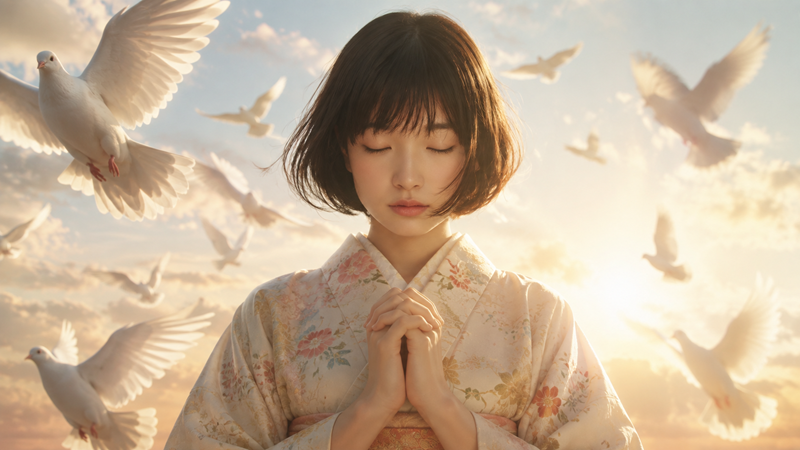
August is nearly over, but the lingering heat shows no sign of letting up. A faint autumn breeze has started to creep in, though I still haven’t heard the higurashi1 I love so much. During Obon,2 the scent of incense drifting from the neighbours left me feeling wistful — perhaps it is the proximity of the anniversary of the end of the war3 that makes me so strangely sentimental. That train of thought leads me to war, and then to my school trip to Okinawa in high school. (A digression: the year group was given a vote on the destination, and the overwhelming majority chose Hokkaido — yet somehow we ended up in Okinawa. The following year’s students got Hokkaido, which caused an uproar. What was the point of the vote…?) Amidst the whirlwind schedule typical of school trips, we had been due to hear a talk from a former member of the Himeyuri Student Corps.4 It was cancelled because her husband had fallen ill. The freed-up time became free activity, and as my friend and I wandered through the Peace Memorial Museum,5 an elderly woman approached us. By coincidence, she herself had been a Himeyuri student — that is, a pupil at the Okinawa Prefectural First Girls’ High School. When we told her about the cancelled talk, she nodded quietly and began to share her own experience. After the Japanese military abruptly ordered them to disband, the students split into two groups — one heading north, the other south — and the direction each group would take was decided by rock-paper-scissors. ‘I lost, so I had to flee north — the dangerous direction. But every one of my classmates who went south, thinking it was safer, was killed,’ she said, closing her eyes in grief. *Because the American forces were advancing southward, heading north meant moving towards them, which was considered the more dangerous option.* ‘I come here from time to time to see my classmates’ faces. This one — she was my friend.’ As she murmured this, gesturing to the photographs of the student corps displayed in the museum, something shifted. The war suddenly felt close. These had been real people — girls our own age, who had studied and enjoyed their hobbies just as we did. The thought was unbearable. When we parted, the woman clasped our hands and said: ‘War must never happen again. I don’t want you to go through what we did. Please — I’m counting on you.’ I remember feeling the weight of those words as an enormous burden. Was there really anything I could do…? Twenty years have passed. Hearing first-hand accounts from those who lived through the war grows harder with each year. We do not know war. How can a generation that has never experienced it pass the memory on to the next? No matter how passionately we speak, we lack the authority of lived experience. It is an immensely difficult challenge. In recent years, some museums have softened their exhibitions — whether out of consideration for American visitors or in response to complaints about exposing children to disturbing material, I cannot say, but the move to conceal the facts troubles me deeply. On top of that, apparently seven in ten people now cannot name the date the atomic bombs were dropped — a figure from an NHK6 survey, admittedly, but staggering nonetheless. And more than forty per cent responded that the bombings were unavoidable. Surely this reflects how thin our awareness of peace has become. When I learn that the people involved in the bombings never uttered a word of apology until the day they died, or that American textbooks frame the bombings as justified, I cannot help feeling that America is the one in need of peace education. Then again, I suspect many people feel the same way about Japan. I have my own modest patriotism, so when I hear the view from abroad that ‘Japan, unlike Germany, has never properly atoned,’ my first instinct is to bristle. And yet I, too, know almost nothing about what Japan did to its fellow Asian nations. History lessons amounted to rote memorisation of dry textbook entries for the sake of exams — learning that left no lasting mark. These days I am trying to remedy that by reading history books on my commute. Still, unless someone has a particular interest in history, they are unlikely to seek out the information on their own, and so the ignorance persists. Or worse, they encounter misinformation online and come away with a distorted picture. Or — let’s be honest — they simply have no interest and are glued to their phones. Who can blame anyone for wanting to think only about pleasant things? As all of this accumulates, I worry that the sense of urgency about war is quietly slipping away. In high school we watched *The Century in Moving Images*7 and films about the Himeyuri students in class. More recently — ten years ago already! — *In This Corner of the World*8 reached a wide audience. Visual media conveys the horror more directly than text alone, and from it one can gain knowledge and receive the message that war is devastating — but it cannot match a living voice. Above all, we watch these films from the safety of our own surroundings, and so we watch them as someone else’s story. ‘It’s dark.’ ‘It’s heavy.’ ‘It’s frightening.’ And — ‘It was a long time ago.’ Yet perhaps it is through direct experience that war ceases to feel abstract and begins to feel personal. During the trip we also entered a gama9 — a place you could only visit, I thought, on a school trip like this. Before we went, talk had circulated every year about students falling ill during the cave experience, framed as ghost stories, and the teachers themselves fanned the flames by using it as an amusing tangent in class. The fact that they treated the place like a haunted house infuriated me then. It still does now. Before we entered, our homeroom teacher and a local guide said with grave expressions, ‘If anyone is especially sensitive to spirits, please speak up,’ which did nothing to calm my nerves. Inside, there was, of course, no lighting. The ground was treacherous. Handrails had been installed in places, but a single slip would send you tumbling — perhaps three or four metres down. Below, I could make out what appeared to be the remains of a latrine. How on earth did anyone get down there? There had been no handrails at the time, and inside this darkness, teenage girls had been carrying grown men… The thought was terrifying. I was lost in these reflections, listening to the local guide, when some boys who had been chattering and laughing were told sharply: ‘There are human bones buried under your feet where you’re standing and laughing.’ I felt deeply ashamed. I was equally appalled when students began posing for photographs at the Cornerstone of Peace,10 whooping and carrying on. They had seen at least some of the harrowing evidence in the museum — how could they treat this place as a photo opportunity? (My friend was asked by a group to take their picture and refused, telling them: ‘This is not a place to mess about.’ Good for her.) I understand the excitement at the soaring sky and the crystal-clear sea. But standing on a small beach, listening to the waves, all I could feel was the crushing weight of the fact that so many lives had been lost in a place this beautiful — the fact that human beings had killed other human beings here. These are the memories that surface on a night like this, as I pray for peace. September already…
Notes for readers outside Japan
1 Higurashi — Tanna japonensis, a cicada whose melancholy call at dusk is closely associated with late summer and the turning of the seasons in Japan. ↩
2 Obon — A Buddhist festival in mid-August (in most regions) during which families honour the spirits of their ancestors. Incense and visits to family graves are customary. ↩
3 Anniversary of the end of the war — 15 August, the date in 1945 when Emperor Hirohito announced Japan’s surrender. It is observed annually as a national day of remembrance. ↩
4 Himeyuri Student Corps (Himeyuri Gakutotai) — A group of over 200 schoolgirls and teachers from two girls’ schools in Okinawa who were mobilised as auxiliary nurses during the Battle of Okinawa in 1945. Over half were killed, many after the Japanese military abruptly dissolved the corps and left them to fend for themselves. ↩
5 Peace Memorial Museum — The Okinawa Prefectural Peace Memorial Museum, located within Peace Memorial Park in Itoman, dedicated to the Battle of Okinawa and the civilian suffering it caused. ↩
6 NHK — Japan Broadcasting Corporation, the national public broadcaster. ↩
7 The Century in Moving Images — Eizō no Seiki, an NHK documentary series that chronicles the twentieth century through archival footage. Widely used in Japanese schools as educational material. ↩
8 In This Corner of the World — Kono Sekai no Katasumi ni (2016), an animated film depicting the daily life of a young woman in wartime Hiroshima and Kure. ↩
9 Gama — Natural limestone caves found across Okinawa, used during the Battle of Okinawa as makeshift shelters, field hospitals, and command posts. Many became sites of mass civilian death. ↩
10 Cornerstone of Peace (Heiwa no Ishiji) — A memorial at Peace Memorial Park inscribed with the names of all who died in the Battle of Okinawa, regardless of nationality or military status. ↩
🕊️ A single click might help brighten someone’s future.🕊️ GreaterGood®