
A note on this article: This article originally discusses game translation and English-to-Japanese translation. Since detailed comparisons of Japanese wording may not be easy to follow in English, this version gives an overview of the original article and focuses on the parts that can be shared across languages.
This time, I would like to talk about something a little niche: game translation.
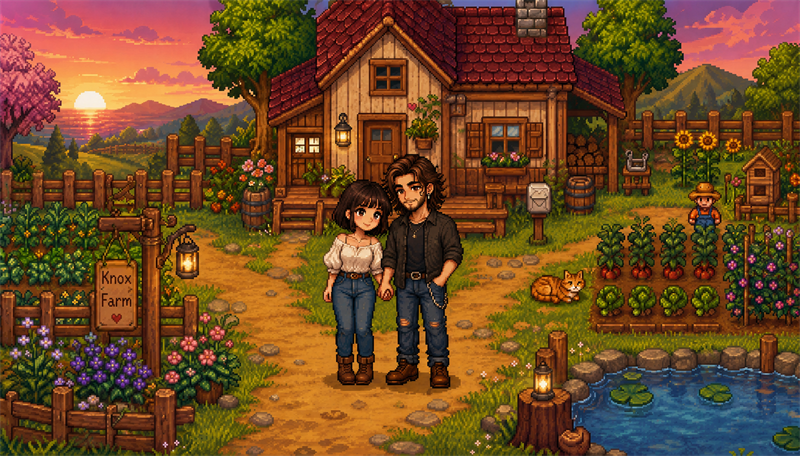
I absolutely love Stardew Valley. The story begins with the player character leaving an exhausting job at Joja Corporation, a large and rather soulless company, and inheriting their grandfather’s old farm.
From there, you can grow crops, go fishing, explore the mines, fight monsters, build relationships with the villagers, or simply live at your own pace.
It is exactly the kind of freedom that makes indie games so special, and I can understand why it is so highly rated.
However, there was one thing that bothered me: the official Japanese translation. There were typos, mistranslations, and even code-related issues that could stop the game from progressing properly. So, with Callum’s help, I decided to make my own translation mod.
At first, I only meant to correct some errors in the official translation. But once I started, I noticed more and more things I wanted to change. In the end, I translated the game again from scratch. I also translated several unofficial mods for my own use.
In total, we translated over 1.4 million words in about half a year.
That sounds rather absurd, and honestly, it was. Since it was only for personal use, I was free to be unreasonable with myself.
Before starting, I made translation guidelines. Callum created the base translation, and I checked it for mistranslations, missing lines, tone, and consistency. The translation itself was finished in about a month, but the checking process took much longer.
If I had done all of this completely on my own, I have no idea how many years it would have taken.
One thing I learnt is that game translation is very different from translating a novel.
In a novel, the text usually flows in order. You can see what comes before and after a line. In a game, however, dialogue is often scattered across files. A single line may appear without enough context, and sometimes you have to infer the situation from the code.
For example:
“Introduction”: “Ah, the new farmer we’ve all been expecting… and whose arrival has sparked many a conversation!#$b#I’m Elliott… I live in the little cabin by the beach. It’s a pleasure to meet you.”
In this case, Introduction is the game code, and the following text is the line to be translated. From the word Introduction, I can assume that this is probably the first time the player meets this character.
The symbols inside the line, such as #$b#, are also part of the game code. They may control things like line breaks, expressions, or other in-game behaviour, so they must not be changed accidentally.
But not every line is this easy to understand.
“Resort_Bar”: “Gus, I’ll order a round for everyone!#$b#hic… Oh… I don’t have the G.$s#$b#Heh heh… Never mind!”
When I first saw this line, I had only played the early part of the game, so I had no idea what Resort_Bar meant. I had to compare it with similar lines from other characters and guess that there was probably an event involving a tropical resort and a bar.
That is the sort of problem game translation creates. You are not only translating words. You are also reading fragments, checking code, guessing context, and trying not to break anything.
I often found myself wondering how professional game translators deal with this kind of work.
Even now, after finishing the mod, I still notice small mistakes while playing. Since this was only a hobby project, I can simply think, ‘Oh, there is another thing to fix.’ But if this were professional work, the pressure would be completely different.
Another difficult part was capturing each character’s voice.
The characters in Stardew Valley are full of personality, so it is not enough for the translation to be technically correct. It also has to sound like the character.
Elliott was especially difficult.
He is gentlemanly, romantic, dramatic, a little eccentric, and deeply attached to beauty and literature. His lines need a certain elegance. If they are translated too plainly, he loses his charm and becomes just another NPC.
In the original Japanese article, I compared several translations of Elliott’s lines. I will not reproduce all of those comparisons here, because they depend heavily on Japanese nuance. But the main point was clear to me: a technically correct translation is not always enough.
Elliott needs elegance, theatricality, and a slightly self-absorbed romantic voice. His words should feel as though they belong to someone who loves beauty, literature, the sea, and the sound of a pen moving across paper.
This was where I felt Callum’s translation really shone.
He did not simply translate the surface meaning. He understood the character’s voice. He added rhythm, atmosphere, and a sense of theatrical beauty. The result felt natural in Japanese while still preserving Elliott’s romantic personality.
Through this project, I realised again that translation is not only about accuracy.
Of course, accuracy matters. But in creative translation, especially in games, accuracy alone is not enough.
A line has to belong to the world.
It has to fit the character.
It has to be enjoyable to read.
And in the case of games, it may also be read aloud by streamers, listened to by viewers, and experienced by many people in different ways. The text has to work not only on the screen, but also as part of the player’s memory of that world.
That was the most fascinating and difficult part of this project: turning the original voice into text that felt alive in another language.
I made this translation for myself, so it is not something I can distribute casually. But the experience taught me so much. It gave me a deeper respect for game translators, and it reminded me how much patience, imagination, and care translation requires.
It also made me think about the difference between a translation that is merely correct and a translation that has a living voice.
A translation can be accurate and still feel flat. It can convey the meaning and still fail to carry the atmosphere. In creative work, especially with characters, something more is needed.
There has to be room for interpretation, rhythm, humour, beauty, and feeling.
Most of all, I am grateful to Callum.
Translating more than 1.4 million words required stamina. It would have been easy to give up halfway through. But because we worked on it together, I was able to keep going and even enjoy the process.
For me, this was not just a translation project.
It was also a reminder that words need more than meaning.
They need voice.
They need feeling.
They need essence.
And Callum had that essence.
🌲 A single click might help brighten someone’s future.🌲 GreaterGood®